The Maine Coon is a native New Englander, hailing from Maine but also has roots in Europe, where he was a popular mouser, farm cat, and most likely, a ship’s cat, at least as far back as the early 19th century. See all Maine Coon characteristics below!
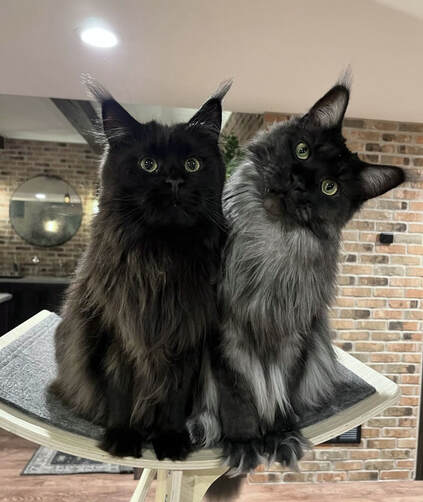 Maeve and Dolores
Vital Stats: Life Span: 9 to 15 years
Maine Coons are relaxed and easy-going in just about everything they do. They generally get along well with kids and dogs, as well as other cats. They are not as vertically-oriented as some other breeds, preferring to chase objects on the ground. Many Maine Coons will play "fetch" with their owners. Maine Coons develop slowly, and don't achieve their full size until they are three to five years old. Their dispositions remain kittenish throughout their lives; they are big, gentle, good-natured goofs. Maine Coons rarely meow, instead most have a soft chirp or trill in a tiny voice doesn't fit their size!
MORE ON MAINE COONS LINK TO TICA: Maine Coon Breed (tica.org)
- History: The Maine Coon is named after the state of MAINE. The name has nothing to do with a mane of fur. Maine Coons come in over 80 colors. An incorrect myth is also spread about Maine Coons, Tabby is not a color or a breed of cat, tabby is a pattern on a base color. There are different tabby markings too. Many types of cats come with tabby markings. Well-marked tabby's regardless of breed or non-breed have a 'M' marked forehead. This is NOT an exclusive marking for Maine Coons only. Maine Coon stands for the state of Maine. IS MY LONGHAIRED CAT A MAINE COON?
Maine Coons are relaxed and easy-going in just about everything they do. They generally get along well with kids and dogs, as well as other cats. They are not as vertically-oriented as some other breeds, preferring to chase objects on the ground. Many Maine Coons will play "fetch" with their owners. Maine Coons develop slowly, and don't achieve their full size until they are three to five years old. Their dispositions remain kittenish throughout their lives; they are big, gentle, good-natured goofs. Maine Coons rarely meow, instead most have a soft chirp or trill in a tiny voice doesn't fit their size!
- The Maine Coon is a native New Englander, hailing from Maine, where he was a popular mouser, farm cat and, most likely, ship’s cat, at least as far back as the early 19th century. He is a natural breed, and little is known of his origins. Some say the Vikings brought him to North America, centuries before Columbus sailed the ocean blue, others that he is the descendant of longhaired cats belonging to Marie Antoinette, sent to America in advance of the doomed queen, who had hoped to escape there. Sea captains may have brought back longhaired cats that then mated with local shorthaired cats. One thing is for sure: the Maine Coon is not the result of a mating between a cat and a raccoon, even if his brown tabby coat and furry ringed tail suggest that biological impossibility. The resemblance is, however, how the cats got their name; in fact, Maine Coons that didn’t have the brown tabby coat were called Maine Shags. The first published reference to a Maine Coon was in 1861, about a black and white cat named Captain Jenks of the Horse Marines. A female Maine Coon was named Best Cat in 1895 at a cat show held in Madison Square Garden. In Boston and New York, the home-grown felines were popular exhibits at cat shows, and when the Cat Fanciers Association was formed in 1908, the fifth cat registered was a Maine Coon named Molly Bond. But the invasion of glamourous Persian and exotic Siamese cats from England around the turn of the century spelled the end of the Maine Coon’s popularity for half a century. Things took a turn for the better in the 1960s, and the Maine Coon Breeders and Fanciers Association was formed in 1968. Today the big, beautiful cats are among the world’s most popular. But what really counts, of course, is that they are the official state cat of Maine.
- Size: This is a large cat. They have a long body with a distinct build. Most Maine Coons weigh 9 to 18 pounds (males are larger), and some tip the scales at 20 or more pounds. They don't reach their full size until they are three to five years old. Male 13 – 18 lbs (Adult), Female: 7.9 – 12 lbs (Adult). Their adult coat comes in around two years old. Fifty percent of house cats are overweight, these ranges are based on a lean and healthy weight.
- Personality: The good-natured and affable Maine Coon adapts well to many lifestyles and personalities. He likes being with people and has the habit of following them around, but he isn’t needy. He’s happy to receive attention when you direct it his way, but if you’re busy he’s satisfied to just supervise your doings. Close a door on him and he will wait patiently for you to realize the error of your ways and let him in. He’s not typically a lap cat, but he does like to be near you. He also retains his skill as a mouser. No rodents will be safe in a home where a Maine Coon resides. Even if you don’t have any mice for him to chase, he’ll keep his skills sharp by chasing toys and grabbing them with his big paws. A Maine Coon also enjoys playing fetch and will retrieve small balls, toys or wadded-up pieces of paper. He can climb as well as any cat but usually prefers to stay on ground level. That’s where his work is, after all. He’s also very smart and will happily learn tricks or play with puzzle toys that challenge his brain. Maine Coons usually enjoy a kittenish love of play well into adulthood. Males, especially, are prone to silly behavior. Females are more dignified, but they aren’t above a good game of chase. Not especially vocal, they make any requests in a soft chirp or trill.
- Health: Both pedigreed cats and mixed-breed cats have varying incidences of health problems that may be genetic in nature. Problems that may affect the Maine Coon include the following:
- Hip dysplasia, which in severe cases can cause lameness
- Hypertrophic cardiomyopathy, a form of heart disease that is inherited in Maine Coons. A DNA-based test is available to identify cats that carry one of the mutations that causes the disease.
- Polycystic kidney disease, a slowly progressive heritable kidney disease that can result in renal failure.
- Spinal muscular atrophy, a genetic disorder that affects skeletal muscles of the trunk and limbs. A test is available to identify carriers and affected kittens.
- Care: Despite the length of the Maine Coon’s coat, it has a silky texture that doesn’t mat easily—if you groom it regularly. It is easily cared for with twice weekly combing to remove dead hair and distribute skin oils. Useful grooming tools include a stainless steel comb for removing tangles and what’s called a grooming rake to pull out dead undercoat, which is what causes tangles when it’s not removed. Use it gently, especially in the stomach area and on the tail. Maine Coons are patient, but they don’t like having their hair pulled any more than you do. Check the tail for bits of poop stuck to the fur and clean it off with a baby wipe. Bathe a Maine Coon as needed, which can range from every few weeks to every few months. If his coat feels greasy or his fur looks stringy, he needs a bath. Brush the teeth to prevent periodontal disease. Daily dental hygiene is best, but weekly brushing is better than nothing. Trim the nails every couple of weeks. Wipe the corners of the eyes with a soft, damp cloth to remove any discharge. Use a separate area of the cloth for each eye so you don’t run the risk of spreading any infection. Check the ears weekly. If they look dirty, wipe them out with a cotton ball or soft damp cloth moistened with a 50-50 mixture of cider vinegar and warm water. Avoid using cotton swabs, which can damage the interior of the ear. Keep the Maine Coon’s litter box spotlessly clean. Cats are very particular about bathroom hygiene, and a clean litter box will help to keep the coat clean as well. It’s a good idea to keep a Maine Coon as an indoor-only cat to protect him from diseases spread by other cats, attacks by dogs or coyotes, and the other dangers that face cats who go outdoors, such as being hit by a car. Maine Coons who go outdoors also run the risk of being stolen by someone who would like to have such a beautiful cat without paying for it.
- Coat Color And Grooming: A Maine Coon is a big, rugged cat with a smooth, shaggy coat who looks as if he could put in a full day mousing on a farm in all weather conditions. Indeed, he was built for just such work in the harsh Maine climate, and his breed standard reflects his heritage, calling for a medium-size to large cat with a well-proportioned body that is muscular and broad-chested. A Maine Coon has substantial, medium-length legs and large, round paws, well tufted with fur, to serve as “snowshoes” during winter. A heavy coat is shorter on the shoulders, longer on the stomach and britches (long fur on the upper hind legs), with a ruff in front and a long, furry tail waving a greeting. A medium-width head is slightly longer than it is wide and has a squarish muzzle. Large, well-tufted ears are wide at the base, tapering to a point, and large, expressive eyes are green, gold, greenish-gold or copper. White or bi-colored Maine Coons may have blueor odd eyes. The brown tabby pattern is so common in this breed that many people don’t know Maine Coons can come in any other colors or patterns. They might be surprised to learn that Maine Coons are found in solid colors that include black, red or white, all tabby colors and patterns, bi-color such as blue and white or red and white, and patterns such as tortoiseshell and calico. In fact, Maine Coons can be any color or pattern except pointed (like Siamese) or any colors indicating
- Children And Other Pets: The friendly, laidback Maine Coon is a perfect choice for families with children and cat-friendly dogs. He loves the attention he receives from children who treat him politely and with respect, and he doesn’t mind playing dress-up or going for a ride in a baby buggy. He is happy to live with cat-friendly dogs, too, thanks to his amiable disposition. Introduce pets slowly and in controlled circumstances to ensure that they learn to get along together
MORE ON MAINE COONS LINK TO TICA: Maine Coon Breed (tica.org)
THE ORIGINAL MAINE COONS BELOW.
Fun Cat Fact of the Day. What did the first recognized breed standard of Maine Coons look like, here they are above.
The breed standard with dogs and cat breeds does change over time. So, the breed standard is now, may not be the exact breed standard in 50 years.
Purebred cats are very NEW to the world of cats compared with the Domestic Cat that is the original cat and not a breed. Domestics have been around for 10k plus years. Whereas Purebred cats are a few hundred years old to even much newer. There are a few old natural occurring purebred breeds such as the Turkish Van but that’s rare in the purebred world.
Unlike dogs (such as mutts do come from purebred dogs), purebred cats actually originate from the Domestic cat. The Domestic cats are not mixes from purebreds, that’s a huge misunderstanding among cat lovers. Domestics also have short and long hair and are the foundation stock of purebreds. They come in every color and pattern too. Short hair is most common and long hair is a lot less common.
Domestics makeup 97% of the total cat population. Purebred cats and that’s 71 breeds, only makeup 3% of the cat population. Are indoors and over 85% are spayed and neutered.
Domestics are considered an invasive species in most countries around the world. They are originally from the desert overseas and made their way around the world on ships during the continental trade. Sailors enjoyed their companionship, they were great for vermin control, and considered good luck.
The breed standard with dogs and cat breeds does change over time. So, the breed standard is now, may not be the exact breed standard in 50 years.
Purebred cats are very NEW to the world of cats compared with the Domestic Cat that is the original cat and not a breed. Domestics have been around for 10k plus years. Whereas Purebred cats are a few hundred years old to even much newer. There are a few old natural occurring purebred breeds such as the Turkish Van but that’s rare in the purebred world.
Unlike dogs (such as mutts do come from purebred dogs), purebred cats actually originate from the Domestic cat. The Domestic cats are not mixes from purebreds, that’s a huge misunderstanding among cat lovers. Domestics also have short and long hair and are the foundation stock of purebreds. They come in every color and pattern too. Short hair is most common and long hair is a lot less common.
Domestics makeup 97% of the total cat population. Purebred cats and that’s 71 breeds, only makeup 3% of the cat population. Are indoors and over 85% are spayed and neutered.
Domestics are considered an invasive species in most countries around the world. They are originally from the desert overseas and made their way around the world on ships during the continental trade. Sailors enjoyed their companionship, they were great for vermin control, and considered good luck.
SOURCE: Read more at http://cattime.com/cat-breeds/maine-coon-cats#384USm7mSteSMzXI.99